Tuesday, February 1, 2011

Association Management Monday: Doodle.com

Every Monday I will be sharing a tip or trick I use to make my life a little easier.

Working with a national professional association, my volunteer leaders are spread across the country, which means scheduling a conference call can be a torturous affair. For the past few years, this dreaded task has become much easier thanks to a website called doodle.com.

Doodle.com is a free service that allows you to create a quick and easy survey of meeting times which can be sent to the people you are trying to schedule. The service does not require registration and can adjust for time-zones.

Making a survey takes less then five minutes. Simply name your survey, select the days you wish to have the call, pick the times and share the link generated with your call participants. If you enter an email you will be notified each time a person completes the survey. Results are tabulated in a red/green chart that makes reading which day and time is the best very easy.


Tips
  • Make sure you enter an email on the first screen to enable notification of when people complete a survey. If you do not do this you will need to make sure you copy the administration url in a safe place, since this will be the only way to view the results (I have used this service for over two years have not received any spam email from them).
  • Although the option of having doodle send survey invitations to participants is available, I have had trouble with those invites getting stuck in spam filters. To be safe I always copy the participant url into an email I send myself.
  • If you have people in different timezones make sure to enable time-zone support in step two. By default it is turned off.
  • Try to keep your options to less than ten. More then that and the survey gets a tad cumbersome to complete.
Final Impression
If you are looking for a quick and easy way to schedule a meeting or conference call, doodle.com fits the bill. The smooth, bare-bones interface makes it easy to setup a survey in minutes and time-zone support takes the hassle out of making sure everyone is on the same page. This tool will transform your 30 chain email string into a simple to read results page.

Sunday, January 30, 2011

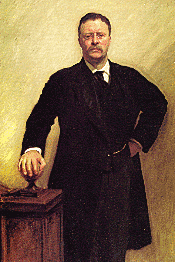
Man in the Arena

Theodore Roosevelt's speeches were masterful works of art. I can only imagine what it must have been like to hear this great man speak. One speech in particular has always struck a cord for me. Given in 1910 at the Sorbonne in Paris, France, this speech's official name is Citizenship in a Republic, but it is more commonly known as "Man in the Arena". In the speech Roosevelt tell us to not worry about failing, to not care about what critics may say, but instead to just go out and do. All that matters is that you try your hardest and you have nothing to be ashamed of.
Below is an excerpt of the most famous part of the speech:
It is not the critic who counts; not the man who points out how the strong man stumbles, or where the doer of deeds could have done them better.
The credit belongs to the man who is actually in the arena, whose face is marred by dust and sweat and blood; who strives valiantly; who errs, who comes short again and again, because there is no effort without error and shortcoming; but who does actually strive to do the deeds; who knows great enthusiasms, the great devotions; who spends himself in a worthy cause; who at the best knows in the end the triumph of high achievement, and who at the worst, if he fails, at least fails while daring greatly, so that his place shall never be with those cold and timid souls who neither know victory nor defeat.
For me this speech always rang true, and gave me comfort when things didn't always work out the way I wanted it to. Make sure your face always has a bit of dust, blood and sweat on it.

To read the whole speech, you can view it here at the Almanac of Theodore Roosevelt.

For anyone interested in learning more about the life of Theodore Roosevelt, I would highly recommend Edmund Morris's trilogy. I have yet to read third installment, Colonel Roosevelt, but if it is at the same level as the first two parts (The Rise of Theodore Roosevelt and Theodore Rex) it will be a good read.

--
Photo: Theodore Roosevelt by John Singer Sargent, 1903
Reference: http://en.wikipedia.org/wiki/Citizenship_in_a_Republic

Tuesday, January 25, 2011

Sal's On Oakland Website Live


For the cost of one haircut, I helped move my long-time barber, Chris, into the digital age! Salsonoakland.com is now live! The site has a simple structure and the content focuses on services provided and what the difference is between a traditional barbershop and stylists. The design of the site does not use any stock photos- everything is taken from pictures I took at the shop.

I am still working on the Yelp site, but should have that complete soon. It will be interesting to see if this brings in some additional customers. I will have a posting soon on why every man should go to a barber.

Thanks to both Adam and Chris for their help on this project!

Thursday, January 13, 2011

Personal Code of Ethics - Part 4 of 4

As a way to understand my perspective, I will be doing four short pieces on my personal code of ethics. This code is how I try to live my life both personally and professionally. This is the second of these installments. Click here to read the first, second and third.

Never Promise Something You Can’t Deliver
Being reliable is something we should all strive for. I’m of the mind that there are very few things you can’t figure out, but in the cases where something just can’t be done, you need to be honest with that so you can move on to what is the next best alternative. If you under-promise and over-deliver, everyone wins.

Never Take Credit for Something you Didn't Do
Although some may say they don’t need or want acknowledgement for their successes, I frankly do not believe this. Everyone enjoys being recognized for their hard work, and everyone deserves it. As a team leader, it is critical to make sure everyone gets the credit they are due. A person who hogs the spotlight and either actively steals credit or even just let people assume they played a bigger role then what was reality will eventually be found out - usually at the most inopportune time.

I believe one of the best testaments to an outstanding leader is how fast their employees are promoted to higher profile job. If the boss is always taking the credit, then it becomes very hard for the employees to progress. This is why this tenant is critical to anyone who wants to be a leader.

So this is the conclusion of my code. I hope that it will help put my posts in a better context.

Wednesday, January 5, 2011

Personal Code of Ethics - Part 3 of 4

As a way to understand my perspective, I will be doing four short pieces on my personal code of ethics. This code is how I try to live my life both personally and professionally. This is the second of these installments. Click here to read the first and second.

Never Set an Opinion or Idea in Stone
One of the saddest result of our current gotch-ya culture is the negative perception revolving around a person who changes their mind. I find it highly ironic that multiple television networks with millions of viewers spend hours a day "debating the issues", but if a pundit would say that after careful consideration of the ideas from the other side, they had changed their mind, they would losing standing and credibility with their viewers and peers and maybe even their jobs.

Instead being looked at as character flaw, I would argue the opposite. Changing your mind shows a person who is willing to swallow their pride and change course when needed. This isn’t to say you should be like a leaf blowing in the wind, but digging your heals in and resisting any change is not constructive. We should be encouraging reflection.

Always Share my Honest Opinion, Even if it Won’t be Well Received
I admit this is probably the part of the code I struggle with the most, because I don’t like making people upset unless it is necessary, but being honest with those around you is an important trait for a person both professionally and personally. If you aren’t willing to share your opinion - especially if you think a choice being made is wrong - you have no business criticizing it afterwards.

Monday, December 20, 2010

Personal Code of Ethics - Part 2 of 4

As a way to understand my perspective, I will be doing four short pieces on my personal code of ethics. This code is how I try to live my life both personally and professionally. This is the second of these installments. Click here to read the first.

Respect Differing Opinions, as Long as They are Based in Fact Not Feelings
Growing up, the capstone of every family dinner at my grandparents were the hours of discussion on the issues of the day. I can still remember my uncle’s gusto, my grandfather’s quite reflection and my mother’s certainty. No matter the difference of opinion, any animosity ended with the last cup of coffee.

Now anyone who knows me, understands I Iove to argue - probably a little too much, but I get very annoyed when it is obvious the other person is only listening to themselves or just dismissing another person’s idea with no reasoning. I do my best to always listen to another perspective and give it the benefit of the doubt. Learning the perspective of others is the only way to understand what has gone into shaping that person’s world-view, and once you understand their world-view it becomes much easier to counter their arguments or actually change their mind or develop a compromise.

Although I respect differing opinions, I have a very short tolerance for people who try to defend their perspective only from an emotional appeal. Emotional arguments have their place, but in serious discussions they do little but work people up unnecessarily and can make the conversation toxic.

Never Stop Asking Why
Too many people are afraid asking questions makes them look weak, but in fact not asking the questions that need to be asked makes a person irrelevant quickly. Asking questions is the quickest way to get to the heart of an issue and I will never stop myself from asking a question if it is needed.

Friday, December 10, 2010

Personal Code of Ethics - Part 1 of 4

As a way to understand my perspective, I will be doing four short pieces on my personal code of ethics. This code is how I try to live my life both personally and professionally. This is the first of these installments.

Always Make Informed Decisions
We are lucky to live at a time where we have an almost unlimited amount of information and opinions to base our decisions on. Unfortunately it seems that too few of us take the time to really analyze information that may not agree with our current viewpoint. When looking at an issue I think it is incumbent to not just dismiss opposing arguments, but instead make sure the decision I am making takes those arguments into account. I feel this interchange is critical to the development of strong arguments, that although you may not agree with them, at least takes your world view into account. Throughout my writing you will see my acknowledgement of opposing viewpoints and what I hope are strong arguments as to why my decision or arguments holds more weight.

Defend My Arguments with Facts, not Feelings
No matter you political affiliation, all can be guilty of using a particularly emotional defense to sway opinion in your favor. I have little tolerance for this and believe it a very disingenuous way of looking at any issue. Turning an argument into little more then a two-year old’s rant makes me think the speaker has either has not done their homework or has little to contribute. In my writings I will do my best to link to any reports or articles I have used to make my point and will not try to hide weak points by making an emotional plea to your senses. I will also do my best not to distort facts to my liking. I will not cherry-pick quotes or use statistics in a way to intentionally distort their meaning.